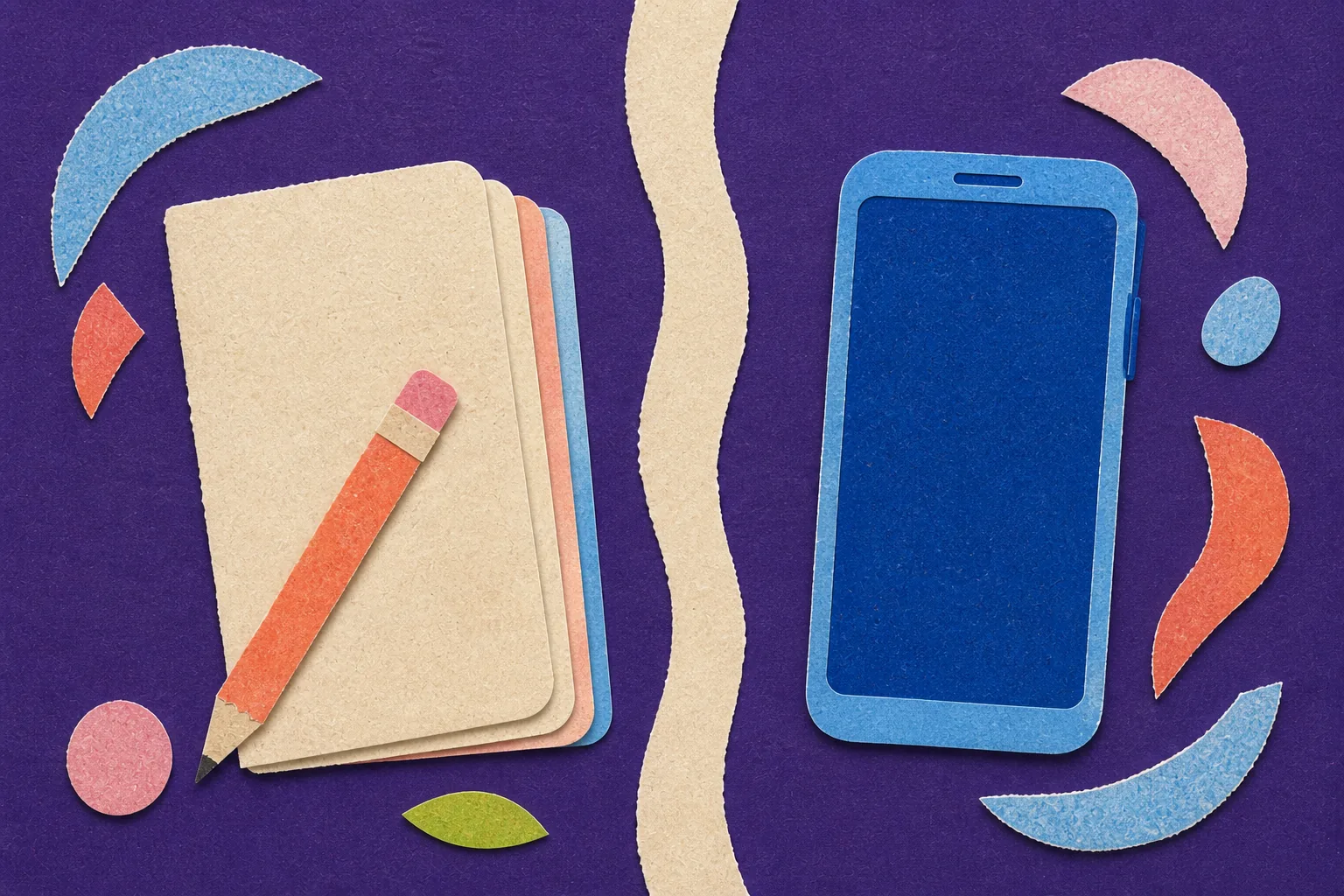
You do not need to choose your journal format for the rest of your life.
Paper people have the good notebooks, the nice pens, and what looks like a better relationship with quiet. Digital people have search, photos, backups, and a journal in the same pocket as the thought they are trying not to lose. Neither side is wrong. The useful question is smaller: what are you trying to make easier?
Choose paper if you want a little more friction
That sounds backward. Friction is usually the thing we try to remove. But some people want a deliberate pause before they write. Picking up a pen can feel different from opening another screen. There are no notifications behind the page. You can draw an arrow, cross something out, tape in a receipt, make a mess, and keep going.
Paper may suit you if writing by hand helps you feel present; your journal is a small ritual; you like sketches and scraps; or you want a place that is not also work, email, group chats, and the internet. It is okay if paper makes you write less but think more. The goal is not a word-count contest.
Choose digital if you need journaling to meet you where you are
Digital journaling is less romantic, perhaps. It is also wonderfully practical. You can write one sentence while waiting for coffee, attach the photo that makes the memory make sense, and find “that awful Tuesday” six months later. A passcode and a backup can make honesty feel safer, too — privacy is worth deciding before format.
Digital may suit you if you think faster than you handwrite, remember things away from your desk, want photos and search, or get nervous about a beautiful blank notebook. There is no prize for making a practice harder than it needs to be.
The sneaky downside of both
Paper can become precious. You wait for the right pen, evening, or first sentence. Digital can become noisy: you open the app to write one thing, see a notification, and somehow end up watching a stranger organize their refrigerator.
Notice which problem is yours. For paper, use a cheap notebook or deliberately make page one ugly. For digital, turn on Do Not Disturb and make the rule: open, write one line, close.
You can use both without creating a complicated system
Give each format a job. The same question applies to input: speaking versus typing changes what you are willing to say. Use paper for slow reflection and digital for quick captures. Or use paper for feelings and digital for photos and details you want to find later. You do not have to sync every thought across both places. That is a project manager’s dream, not necessarily yours.
Try paper for seven days, then digital for seven. Each time, answer: “What happened today that I might want to remember?” Choose the one you open without negotiating with yourself.